The DC-3: The Plane That Changed Everything
Before the DC-3, airlines lost money carrying passengers. After the DC-3, they could turn a profit. That simple economic fact sparked a transportation revolution whose effects are still felt in every airport terminal in the world.
Introduction
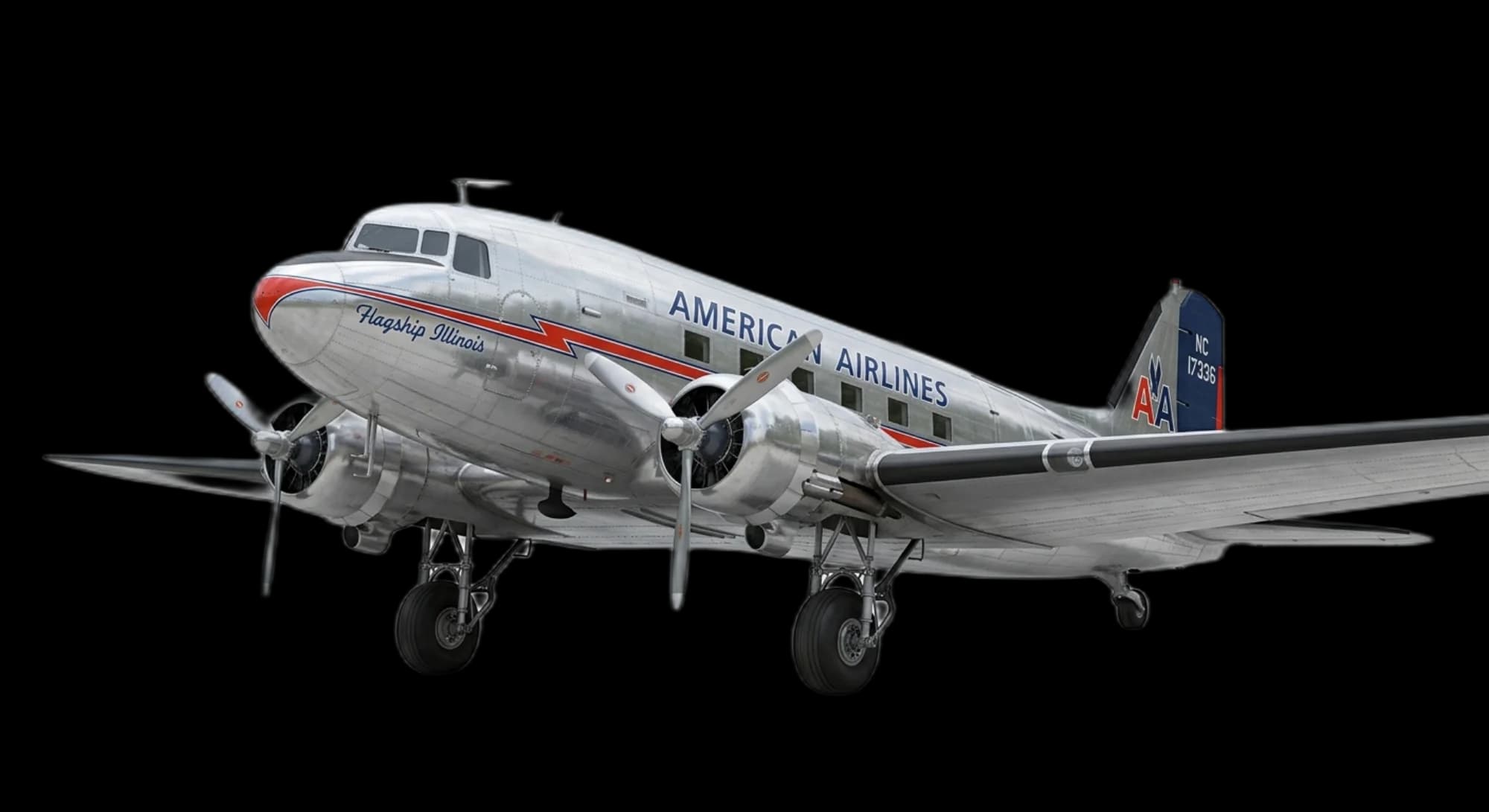
General Dwight D. Eisenhower, reflecting on the tools that won the Second World War, named four: the bazooka, the Jeep, the atomic bomb, and the Douglas C-47. The C-47 was the military variant of the DC-3, a commercial airliner first flown on December 17, 1935, exactly 32 years after the Wright brothers' first flight at Kitty Hawk. No aircraft before or since has so thoroughly transformed both civilian and military aviation.
The Economics of Flight
In the early 1930s, commercial aviation was an expensive curiosity propped up by government airmail contracts. Airlines carried passengers mainly as supplementary revenue. The aircraft available, biplanes and early all-metal monoplanes like the Boeing 247, were small, slow, uncomfortable, and incapable of generating profit from passenger fares alone.
The DC-3 changed this calculus entirely. Developed at the request of American Airlines president C.R. Smith, who wanted a wider, sleeper version of the successful DC-2, the DC-3 emerged from the Douglas Aircraft Company's Santa Monica factory as the first airliner that could make money carrying passengers without airmail subsidies. It could seat 21 passengers in its standard configuration, or 14 in sleeper berths for overnight flights. Its two Pratt & Whitney or Wright radial engines gave it a cruising speed of 170 mph and a range of 1,500 miles.
The numbers told the story. The DC-3's operating costs per seat-mile were low enough that airlines could offer affordable fares and still profit. By 1939, DC-3s carried 90 percent of all commercial air traffic in the United States. Airlines that operated the type, including American, United, TWA, and Eastern, expanded rapidly. New routes opened. New passengers flew for the first time.
Design and Innovation
Chief engineer Arthur Raymond led the DC-3 design team at Douglas. The aircraft incorporated several features that were advanced for its time: stressed-skin aluminum construction, retractable landing gear, variable-pitch propellers, and wing flaps that allowed shorter takeoff and landing distances. The fuselage was wide enough for two rows of seats separated by an aisle, establishing the basic cabin layout that persists in regional aircraft to this day.
But the DC-3's true genius lay in its ruggedness. The aircraft was built to absorb punishment. Its fixed tailwheel undercarriage was simple and strong. Its systems were straightforward and maintainable by mechanics with basic tools. It could operate from unpaved runways, grass strips, and even packed snow. This durability, unremarkable in peacetime, would prove decisive in war.
The C-47 Goes to War
When the United States entered the Second World War, the military commandeered the DC-3 design and produced it in vast quantities as the C-47 Skytrain (known to the British as the Dakota). Over 10,000 military variants were built during the war. The Soviet Union produced an additional 5,000 under license as the Lisunov Li-2.
The C-47 served in every theater. It dropped paratroopers over Normandy on D-Day, with over 800 aircraft participating in the airborne assault on June 6, 1944. It flew the Hump, the treacherous air route over the Himalayas from India to China, carrying supplies that kept the Chinese war effort alive. It evacuated wounded from Pacific island airstrips. It towed gliders. It carried ammunition, food, medical supplies, and personnel across every front.
The aircraft's ability to operate from rough, unprepared fields made it indispensable. In the Pacific, Marines would secure a Japanese airstrip, lay down steel matting, and have C-47s landing with supplies within hours. No other transport aircraft of the era combined the payload capacity, range, and rough-field capability of the C-47.
The Berlin Airlift
The DC-3/C-47 played a crucial role in one of the Cold War's defining moments. When the Soviet Union blockaded West Berlin in June 1948, the Western Allies organized an airlift to supply the city's 2.5 million residents. C-47s were among the first aircraft committed to the operation, flying round-the-clock missions into Tempelhof Airport.
The C-47's limited payload capacity (roughly 3.5 tons compared to the C-54 Skymaster's 10 tons) meant it was gradually replaced on the Berlin run. But the aircraft had bought time during the critical first weeks when no alternative existed.
Still Flying
Perhaps the most remarkable fact about the DC-3 is that it remains in active service. More than 90 years after its first flight, DC-3s and C-47s continue to operate in cargo and passenger roles in remote regions of Africa, South America, and the Canadian Arctic. Basler Turbo Conversions in Oshkosh, Wisconsin, still modifies surplus C-47s with modern Pratt & Whitney turboprop engines, updated avionics, and extended fuselages, producing the BT-67 for military and civilian customers.
The type's longevity is not sentimental. Operators continue to fly DC-3s because, for certain missions, nothing else does the job as well. The aircraft can land on short, unprepared strips that would destroy more modern types. Its maintenance requirements are simple. Spare parts, after 90 years of production and salvage, remain available.
A Singular Achievement
The DC-3 occupies a unique position in aviation history. It was the aircraft that proved commercial aviation could sustain itself economically. It was the transport that moved Allied armies across continents. It was, in Eisenhower's judgment, one of the four things that won the war. And it is still flying.
No other aircraft has so completely bridged the gap between commercial innovation and military necessity, or maintained its relevance across so many decades. The DC-3 did not just change aviation. It changed the expectation of what an aircraft could be.
Written by Singular Heritage Team
Published January 16, 2026 · 6 min read
Part of the Singular Heritage network